I Keep Having to Find the Spoons Again
June 2026 | Turquoise Trail Letter
We are about to move again.
I've been in Minnesota for a stretch, visiting all the people I love most, walking familiar streets, bracing the unseasonally cool spring air and enjoying the incredible blossom show she put on this year. Now I head to Kuala Lumpur for two months.
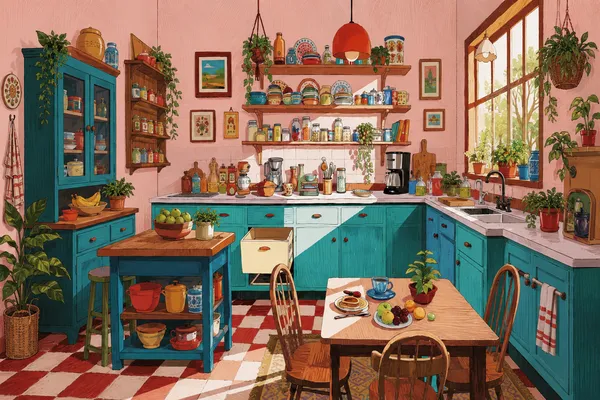
This is the part of nomadic life that doesn't get romanticized on Instagram: the forty-eight hours in a new place where you can't find anything. Where are the water glasses? Which switch turns on which light? How long until the hot water kicks in in the shower?
You'd think by now I would have gotten comfortable with this particular discomfort.
I haven't. But I have gotten better at it, which I suppose is the whole point.
The Remapping
Each new environment is a remapping project.
My brain, now very cozy with Minnesota, with the particular smell of my sister's home, the exact geography of a kitchen that is second nature to me has to start over. It has to learn. It has to pay close attention in a way that the familiar doesn't ask it to.
This is not nothing.
When we're in a known environment, we move through it on autopilot. The knifes, the cutting board, the spoons are where they always are. We assume our way through the day, and there is real relief in that. There is ease in the known, the comfort of not having to work to be functional.
But when everything is new, we cannot make assumptions.
We have to observe.
We have to pay attention.
We have to look and remap.
And that, I've come to believe, is one of the most underrated practices in a world that is moving faster than most of our nervous systems can handle.
The Skill Underneath the Skill
What is all of this actually building in me?
Because I do believe it is building something.
Every time I move into a new environment and have to remap, I am exercising a flexibility. A willingness to begin again. A capacity to stay functional -making coffee, writing, showing up for clients even when nothing feels quite right yet. Even when my body is still looking for things that aren't where they used to be.
Neuroplasticity is the word the brain researchers use. The brain's ability to reorganize itself, to form new connections, to learn. We tend to think of it as a young person's game, but the research says otherwise, and my own experience says otherwise.
Every new environment is a neuroplasticity workout.
Every time you find where the spoons are "this time", you are keeping that part of you alive and elastic.
On Adaptability
I've been sitting with adaptability as the theme for this month's letter because it is, honestly, the skill of this moment. Not just for travelers for all of us.
The world is in flux, and within that larger flux, most of us are navigating our own personal versions of it. Change in work, in relationships, in health, in the places we call home, in the beliefs and sometimes the routines we used to rely on.
Real adaptability is not the same as just rolling with it. That's too passive.
What I'm working on in myself and with my clients looks more like this, and I think the order matters:
Acceptance of what is. Full stop. Not begrudging acceptance, not resigned acceptance, but actual, energetically clean acceptance. Here is what is true right now.
Discernment. From that clear-eyed place, what is actually being asked of me? What is mine to address and what is not? What is the next right thing?
Action. Specific, intentional, chosen. Not reactive. Not driven by the panic of uncertainty, but by the clarity that arrives after you've stopped fighting what already is.
Acceptance, then discernment, then action. In that order.
Because when we skip to action too fast, when we try to outrun the discomfort of uncertainty, we're usually just burning energy. A lot of it. Resistance is expensive. The body knows this, even when the mind wants to argue otherwise.
On Being Functional Within the Discomfort
The goal is not to feel better.
The real, hard, valuable goal is to be functional even when you don't feel better. To be able to move, to think, to choose, to act, even in an agitated state. Even when your body is running on high gear, when your mind is twitchy, when you can't quite get a full breath.
We spend a lot of time seeking regulation, and I understand that because the relief when it arrives is so real. But I think there is a deeper practice underneath: learning to widen the range of states in which you can still function. Learning that discomfort is not a stop sign. Learning that uncertainty in the body does not mean danger.
It is being okay with not being okay and still moving.
The power of observation is the foundation of all of it. Before adaptability, before tolerance of uncertainty, before acceptance and discernment and action there is the simple, radical act of paying close attention to where you actually are.
Not where you wish you were. Not where you used to be. Not where you're heading.
Here. Now. This space. These walls. This light. These circumstances.
What is actually true right now?
That is always the first question. And it is always harder than it sounds.
If you are navigating your own kind of remapping right now, and I suspect many of you are, the disorientation is not a problem. It is the process. It is the nervous system doing its honest, effortful work of learning new terrain.
Give it time. Pay attention. Find the spoons.
We are all figuring out where things are, in this new and rearranging world. You are not behind. You are, in fact, right on time.
The Turquoise Trail community is a space for women navigating exactly this kind of work ” the inner and outer rearranging, the building of real, lived resilience. If you want to do this alongside women who get it, come walk with us in the Turquoise Trail community.
SHARE THIS LETTER
Send this to the woman in your life who is in the middle of a remapping.